
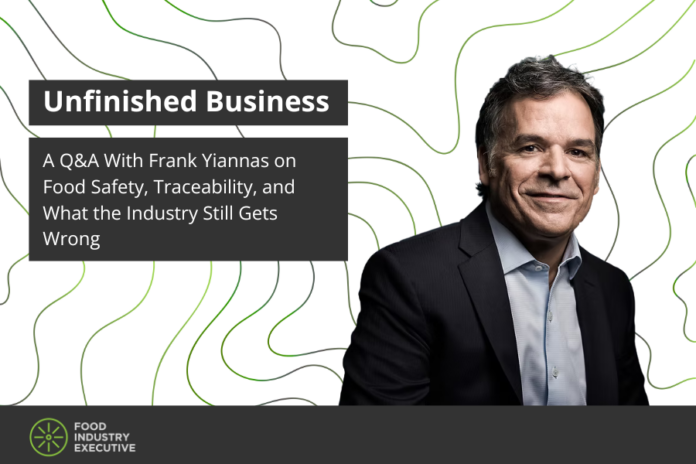
Frank Yiannas has spent 35 years trying to prevent foodborne illness, first at Disney, then as a food safety executive at Walmart, then as Deputy Commissioner for Food Policy and Response at the FDA, and most recently as a key advisor to Boar’s Head during one of the most high-profile Listeria outbreaks in recent memory. He’s widely credited as the architect of the FDA’s food traceability rule, the author of two books on food safety culture, and one of the few people in this industry who has sat at every table, from corporate boardroom, to federal agency, to plant floor.
This year, we named Yiannas as one of the 25 Most Influential Food & Beverage Executives of 2026. He’s not a CEO. He’s not running a major corporation or heading a government agency. He made the list because, as he’ll tell you, influence looks different now. And he’s using every bit of it.
We caught up with Frank to talk about what it was like to walk into Boar’s Head mid-crisis, where the industry actually stands on traceability readiness, why food safety culture isn’t a slogan, and what he’s most optimistic about for the future of food.
Q. You stepped into the Boar’s Head situation during one of the biggest foodborne illness outbreaks in recent years. What was that experience like?
Frank Yiannas: I’ve been fortunate, even blessed, to have worked for some amazing brands. But a couple of years ago, a major Listeria outbreak associated with deli meats occurred, and I was asked whether I wanted to help.
When a company reaches out in a crisis like that, you have to ask a lot of questions. You have to make sure they’re genuine, that they have empathy, and that they want to do the right thing transparently. They convinced me. So I went in.
We did a root cause investigation, which has to happen after these events so that we actually learn from them. Too often, companies don’t do that work. They might throw a supplier under the bus, but that doesn’t implement what I call lasting solutions. Boar’s Head put real, sustainable controls in place, including high pressure pasteurization and water pasteurization of their products, without affecting the quality customers expect. The facility reopened earlier this year.
Q. You stayed on as an advisor even after a permanent Chief Food Safety Officer was hired. What kept you there?
FY: The way they showed up. In a crisis, a lot of companies start with disbelief; they just don’t want to believe it could happen to them. That didn’t happen here. They pulled product before there was even a genetic link confirmed. They committed to complete transparency, brought in outside advisors, including David Acheson and Martin Wiedmann, and implemented every recommendation I made.
I’ve always found, whether in a crisis or just making career choices, that alignment in values and beliefs matters. That’s why I worked at Disney, why I went to Walmart, why I went to federal service.
Q. You’ve described better traceability as the Achilles heel of the food system. The FSMA 204 compliance deadline has now been pushed to July 2028. What’s your honest read on where the industry stands?
FY: Let me give a little context. When I got to the FDA, people often described me as the architect or father of the food traceability rule. The reality is that Congress directed the FDA to write this rule when they passed FSMA, signed by the president back in 2011. The agency got sued by two consumer groups. They had an enormous amount to do and never got the full resources they needed. So there are real reasons why it was delayed.
When the deadline got pushed to 2028, I was candid about it. I would have preferred enforcement discretion, keeping the rule on the books with the original date and keeping the pressure on. But I also have empathy. It’s a difficult lift for parts of the industry.
That said, when I get out and visit companies, we’re making tremendous progress. People have budgets for it. They’re speaking the universal language of food traceability. Five years ago, nobody knew what a critical tracking event or key data element was. The hardest piece is still that last mile: distribution centers to retail or food service, because it’s a one-to-many node and it involves process changes. But I think we need to get on with it. We’ve been at this for 15 years.
Q. You were early on the blockchain traceability story with the mango pilot at Walmart, tracing mangoes back to source in 2.2 seconds, versus seven days the manual way. How has the technology evolved since then?
FY: The underlying technology, whether centralized or distributed ledger, has matured and runs more efficiently. But the real evolution I’ve seen is in smart labels and scanning. We’re seeing optical readers replacing manual scanning, and RFID is showing up in a big way across retail. Chipotle is using it on inbound product. Kroger, Walmart… They’ve all made announcements. There’s also next-generation RFID, what some are calling Ambient IoT.
Think about the powdered infant formula recall this past year, where recalled product was still showing up on store shelves months later. In a world with smart labels, that doesn’t happen. You could locate that product instantly instead of relying on recall notices. High-value, high-risk products like infant formula should be at the front of the line for this technology.
When you do the cost-benefit analysis, there’s a real return on investment in food safety and public health alone through minimizing expansive recalls and containing outbreaks faster. But that’s not the real value proposition. The real value proposition is running smarter, more efficient supply chains.
And I’ll tell you a story I don’t usually share publicly. When we did the mango pilot, we could see exactly where friction existed in getting fresh product to consumers. Every day you remove from the supply chain is a day of shelf life you return to the customer. On a low-volume SKU, we projected the savings from better supply chain visibility alone were in the millions of dollars.
Q. You’ve been working on food safety culture for decades. You wrote the first book on it back in 2009, and you recently partnered with Aquatic to license that workshop globally. Why now?
FY: I wrote that book because food safety culture was the missing link for me. I’m a microbiologist by training. I could write a good HACCP plan. I could identify risk and implement the right controls. What was missing was how to influence human behavior at scale, whether that was 200,000 cast members at Disney or 2.2 million associates at Walmart.
When I was at Disney, they tapped me to help with occupational safety and health beyond food. That domain was further along. They were already talking about human behavior, organizational culture, and how providing the right tools and knowledge alone isn’t enough. I brought those concepts into food safety and started getting better results.
If you look at any catastrophic failure, the investigation always comes back to a culture that allowed it to happen. The hard science matters. But it’s the soft stuff that’s the hard stuff.
I get invited to a lot of conferences and companies, and I can’t do it all. I’m not interested in building a big consulting firm. So I partnered with Aquatic in Norway, who does work across Europe and South America, to train their trainers and spread what I’d call the gospel of food safety culture.
Q. You mentioned you’re advocating for a National Foodborne Outbreak Investigation Board, modeled on the NTSB. What’s the case for it?
FY: If you think about all the outbreaks and recalls we see in the news, how often do you actually hear what happened and what was done to prevent it from happening again? Almost never. Root cause investigation is not done well enough, and I say that with no criticism aimed at any particular sector. It’s a systemic gap.
The NTSB investigates every major aviation incident. They learn from it. They publish findings. The whole industry benefits. We need that same model for food. Too many outbreaks produce too little learning. That has to change.
Q There’s been enormous movement in food policy in the past year. How are you thinking about where regulation is heading?
FY: I’m genuinely pleased that the conversation has been elevated. Food safety and nutrition are getting more political attention than I’ve ever seen. I personally tried not to make food safety a partisan issue. Safe, healthy food is good for everyone, regardless of party. But if the attention leads to action, I’m for it.
My concern is risk ranking and prioritization. When I was at the FDA, there were 101 things we could work on. You have to ask, which ones will have the greatest public health impact?
I’ll give you an example: I have no issue with removing artificial dyes from food. They’re not needed. But let’s not oversell it as a public health breakthrough. I want to make sure we double down on the target-rich environments, and that means not forgetting about microbes. Salmonella, E. coli, Listeria… Pathogens still cause enormous harm. We can’t let the focus on food additives and chemicals pull our attention away from what still kills people.
Q. You were named one of our Top 25 Most Influential Food and Beverage Leaders for 2026, the only person on that list who isn’t a CEO. What did that recognition mean to you?
FY: It was touching, honestly. I’ve received recognition over the course of my career, but this was different. What struck me most is what it signified.
Influence looks different today than it did 20 years ago. I don’t think my name would have been on that list 20 years ago, because 20 years ago, influence was largely tied to the size of your title or your organization. Today, because of technology and the ability to get out there and still have a voice, that’s changed.
So what it meant to me isn’t really about my name on a list. It’s that it confirmed the conversation is bigger now. You don’t have to be a CEO. You don’t have to be in a big company or a government agency. You have a role to play, and you can play a big one.
Q. What do you know now about food safety and this industry that you wish you’d understood earlier in your career?
FY: There’s a difference between knowledge and experience. The next generation of leaders coming up, they’re impressive. They come out knowing so much. But experience is different. If you’re going to get on a plane in rough weather, you want Captain Sully, not someone who just graduated from flight academy.
What I know now that I didn’t fully appreciate early on is how interconnected and interdependent this food system is. The pandemic didn’t cause havoc because we ran out of food. It caused havoc because people weren’t showing up to work, and 3 to 5% disruption in labor is enough to break the food system. The conflict in the Middle East affects fertilizer, which affects production. Everything is connected, and we don’t yet have the models to forecast those ripple effects.
I also understand more deeply now that this is still a people-led system. It’s manual, it’s labor-intensive, and food policy has to always keep the human element in view.
Q. What are you most optimistic about?
FY: I’m genuinely not a pessimist. Three technologies in particular give me real optimism.
- The genomic revolution has been game-changing for food safety and food production, and we’re still early. We’re still scratching the surface of what it can do.
- Automation is in a boom period. People get nervous about what it means for jobs, and those concerns are valid and worth taking seriously. But equipment and machines, designed correctly, can be far more consistent than humans. This next wave of automation will be more powerful than anything we’ve seen, far beyond the mechanical automation of the 20th century.
- And then data and AI. I said five years ago at the FDA that we’d see more change in food and ag over the next decade than I’d seen over my entire 35-year career. I believe it even more now.
Ultimately, we’re going to get this right. Food is too important not to. I think it leads to a safer, smarter, and more sustainable food system. And that’s why I’m still out there, still using the hashtag I started when I left the agency: unfinished business.