
AI is on the plant floor now, but there’s a big difference between experimenting with it and getting real value from it. Some projects never launch because the underlying data isn’t clean enough to feed it. Others make it to a pilot and stall there, undone by generic tools or by IT teams hunting for a problem to solve. The food and beverage companies that avoid pilot purgatory tend to work backward from a real business problem rather than starting with the tool.

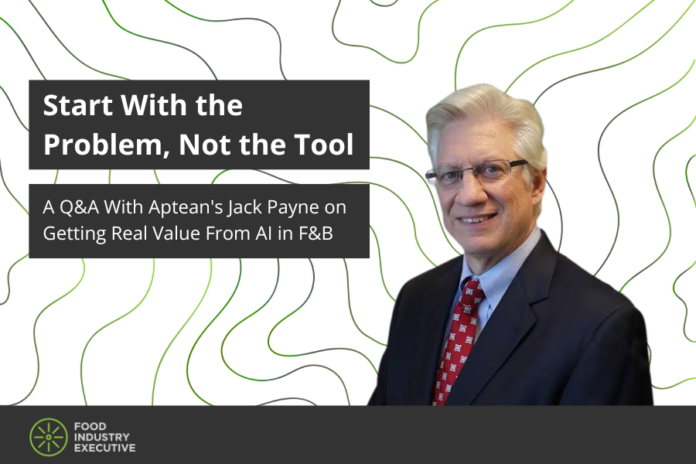
Few people have watched that shift longer than Jack Payne. With more than 30 years in food and beverage technology and deep expertise in traceability and supply chain innovation, Jack helped develop Aptean‘s industry solutions and wrote the book Appetite for Success: Thriving with Technology in the Food and Beverage Industry, a guide to moving operations from reactive processes to intelligent, future-ready foundations.
In this conversation, Jack explains why food data is particularly challenging for generic AI tools to understand, what separates the pilots that scale from the ones that stall, where AI is paying back fastest, and why prevention is the next frontier for food safety.
Q. You’ve been in food and beverage tech for three decades. What has changed the most about how a plant floor runs today versus when you first started?
Jack Payne: Big changes. Think about 30 years ago. Most people didn’t even know what the internet was. There was no concept of a smartphone. Very few people had a cell phone, and if you had one, you were judicious about using it, because you were charged something like 35 cents for every minute you used it. So 30 years ago, it was basically written instructions going out to the floor. You wrote everything down on a piece of paper. If a company had a computer system, that piece of paper went back into the office and somebody keyed it in maybe 24 hours later, then ran a report at the end of the week. That was 30 years ago, and I still see some companies operating like it’s the 1990s.
Now, with the internet and smartphones, plus IoT, tablets, devices, and AI, it’s a completely different world. We’re still making food and we’re still tracing food, but the whole technology around how we make safe food has changed.
Q. Data quality is often cited as the single biggest obstacle to getting real value from AI, ahead of budget, talent, and leadership buy-in. What does that problem actually look like inside a food plant, and why is it harder to fix here than in some other manufacturing sectors?
JP: I can’t speak to other manufacturing sectors, but in food, AI consumes a lot of data. It’s data-hungry, and it needs good data. When I go into most food companies, there are multiple sources of data. If they have formal systems, they’ll typically have an ERP system. They may have an OEE system, an EAM system, and a WMS. They’ll have multiple systems, probably integrated in some way, but they need data from all of them together. So a lot of the time you’re pulling similar data from multiple sources. What’s a customer in one system may be an account in another. What’s a part code in one may be a SKU in another. There’s a rationalization of that multi-source data that has to happen.
On top of that, if you’re extracting data into a database or cloud data platform, there’s typically a delay, often 24 hours. Then you have to think about spreadsheets and tribal knowledge, and how you make all of that available to AI. It’s a challenge, and not just for AI projects.
I recently worked on some supply chain implementations and saw the same thing: not having all the data, and accurate data, in the ERP and inventory systems to feed the supply chain. It’s a common problem, but we see it bigger with AI, because AI has to consume accurate, high-volume data to do its job.
Q. Say a company gets its data house in order. That’s usually when a pilot starts, and it’s also where a lot of them stop. In food and beverage, what do the companies that make it into production and scale across all their facilities do differently from the ones that get stuck?
JP: There are three different approaches companies take. Sometimes it’s a do-it-yourself approach, where the more analytical, tech-savvy, or IT people use tools like Gemini or ChatGPT and try to solve their specific challenges or problems. That’s definitely the wrong thing to do, because now you’re sharing data. It’s typically called a ghost AI project. But it happens because those people are genuinely interested in understanding how AI can improve their business.
When you move past that to a formal AI effort, you get two options: a generalized, generic AI solution, or one that’s food and beverage specific, a vertical industry solution. Those first two categories are where people start to fall down. They try to do it themselves, sometimes even licensing enterprise tools, and they use generic tools. A generic tool isn’t going to know shelf life. It isn’t going to know yields, co-products, byproducts, catch weight, traceability, or recall, all the things that are just part of the world of food and beverage. You have to train it on those, and that’s where it starts to fall down, in not having the training and the knowledge.
When you move into industry-specific tools, they do understand the language of the industry. But the thing to watch out for there is whether it’s an IT-led project that said, “Let’s use the latest toolset and go find a problem to solve,” or whether the business users are involved in defining the business case and the use case.
I was involved in one just this past week where there was a very well-defined use case and a well-documented process, and we were able to build an AI workflow that did exactly what they were doing. It cut out a lot of work, was more accurate, and it gave them the information they needed a month earlier than when they were doing it manually.
You don’t need to build an AI agent or workflow and then look for a problem. You need to ask, “What’s the business challenge I need to address, and what’s the use case for applying AI to it?”
Q. When you walk into a plant that’s AI-forward and using it day to day, where are people getting the most value, versus where executives say they want to put more budget next? Is there a gap between the two?
JP: When executives think about it, they’re looking at the benefit to the bottom line. There may be plenty of places where we can use AI to automate processes, create efficiencies, and make better decisions, but how do you quantify the effect on the bottom line? What we want is the business leaders and executive-level leadership involved to help define those use cases and challenges.
One area we’ve seen is margin analysis. Over the past year, a company realized the margin on certain products had eroded, but they didn’t know why. Was it a cost problem? An efficiency problem? A yield problem? Were they not keeping sales prices up to date? Were they running promotions? It was taking an army of people a couple of weeks to figure that out a month after the fact. Being able to build a margin analysis agent that gives them daily information, and can actually predict margin before you ship the order and invoice the customer, and then accurately confirm it afterward, solves that problem.
Another big area is inventory and supply chain. A lot of these are systems where people rely on tribal knowledge and external spreadsheets to manage, so applying AI there is really helping them improve their supply chain practices. We also see a lot of interest in procurement: qualifying suppliers, making sure orders get to suppliers, and communicating with them.
Q. Traceability has huge implications in food, where one bad batch can turn into a recall. Where are you seeing AI actually impact traceability, recall response, and food safety, and where is it being marketed more than it’s delivering?
JP: Good question, and I’m glad you brought up food safety and the prevention side, because in food safety, 90% is prevention. The rest is response, which is basically traceability and recall. Most of what I’ve seen from the early adopters in traceability or food safety is on the traceability side: how do we get a faster response?
One of our customers was using our vertical-specific tools, and I was amazed at the improvement in their traceability. They reduced the time and effort to do a traceability check or mock recall by 95%. And I’m thinking, even if they hadn’t had a food-specific ERP, they probably would have cut it by 90%. They went from hours to virtually minutes, which is critical anytime this happens.
What I haven’t seen as much is people thinking about how to apply this to the prevention side, and I think that’s going to be the big benefit. It involves analyzing data to find areas of risk where you could have food safety problems. How do you evaluate risk? Is it new employees? Is it a particular product on a certain line, a certain shift, or a certain crew where you tend to have trouble? AI can help analyze that information to see where the risk is, and then it can make recommendations. It might say, “You should never run this product on a Sunday night third shift, because it’s the start of the week, you’ve got newer employees, and there may not be as much supervision.” Things that make sense but that we might not think about on our own. It might say you need to do more training. It could provide information in real time to operators and users to prevent an incident in the factory.
That’s really the next big frontier: looking at the prevention side of food safety, and how we employ AI and various AI tools to make sure we don’t have to have a recall.
Q. On regulation, do you think the pressure to stay ahead of compliance is pulling this technology forward, or is the tech already leapfrogging where the regulations are headed?
JP: We’re seeing companies today dealing with the challenge of FSMA 204 compliance within two years, and a lot of them are struggling with it. It’s the basics of what you have to have for all this information, and it’s a lot more than basic traceability. Things like the unique lot code, and having additional supplier and customer information as part of your traceability records. That’s where AI can really help us collect that information. If we have the proper supplier records, the proper supplier certifications, and the proper customer records, AI can help pull that data together and feed it in.
The FDA says to submit an electronic, sortable spreadsheet, but the first step is you have to have the data in the first place. At some point they’re not going to ask for a spreadsheet. They’re going to want a specific file format uploaded. And it won’t be only when there’s an incident. It’s going to become part of your business, something you keep maintained, like other industries do, like the pharmaceutical industry. This is a big area where AI can provide industry-wide benefits as well as consumer benefits in ensuring safe food and rapid response in the case of a food safety incident or recall.
Q. Food margins are thin and getting squeezed. What AI investments are you seeing pay back the fastest right now, and what’s a realistic payback window?
JP: The first one I mentioned earlier is margin analysis. That can pay back pretty fast. Anything that improves efficiency, and efficiency can sometimes be hard to quantify, but it gives you better information faster, and tools that make recommendations for us, those are the areas that pay back.
We’ve seen it with sales and customer order patterns. Maybe a customer typically orders 10 cases, but this time they ordered 100. Or somebody entered the order incorrectly, and it doesn’t get caught until the customer calls wanting to return 90 cases. AI can track those patterns and save us that cost, save us that money. Or if a customer isn’t placing an order, we can follow up and understand why.
A big advantage that’s maybe hidden is what I’ll call employee morale, job satisfaction, and employee retention. That’s a big number. I read an article about one of the major retailers and their focus on employee satisfaction and retention, and they’ve actually put a dollar amount on what it costs to hire and train a new employee when one leaves. Those are real, hard numbers, and I think we sometimes miss that morale and satisfaction piece as part of what helps us here.
Q. On a global scale, North America looks a bit ahead of Europe on AI in food and beverage, and regulation seems to play a role. In your experience, does heavier regulation slow adoption overall, or does it just change what gets adopted first?
JP: This is interesting, because over the last 20 years my observation has been that Europe tends to be more progressive, and an earlier adopter of technology, than North America. Years ago it was hard to find an internet hotspot in the United States, but you’d go to Europe and they were everywhere. That’s just one example.
But the regulations, and I think these are smart things Europe is doing, are putting rules around AI, so companies are moving cautiously. There’s also GDPR. Even though a lot of US companies adhere to those privacy regulations, it’s a very stringent regulation in Europe. That, coupled with some of the AI regulations, isn’t slowing the need or the desire, but it is slowing the deployment of AI technology in Europe.
Q. Over the long term, will that be an advantage or a disadvantage?
JP: Some of the early adopters with AI are like a kid in a candy shop. Suddenly AI is this shiny new tool, and they’ve come up with 20 use cases and want to apply AI to all 20. But like anything, it’s a learning process: crawl, walk, run. We’ve seen companies want to do 20, and after the first two or three they say, “Wait a minute, we’ve learned a lot from these first experiences. We want to change what we’re doing down the road.”
That’s the advantage I think we’ll see in Europe. As they roll it out a little slower, they’re going to learn how to use it better and build better use cases, rather than just saying, “Give me all I can get.”
Q. If a food manufacturing executive came to you today and asked what one AI move they should make this quarter, what problem would you tell them to look at first?
JP: I’ve got two answers. For a general food and beverage company, I’d say look at forecasting and planning. A lot of companies just don’t do a good job at forecasting, and its bottom-line benefits are well documented. And if we can make the planning process and the supply chain work together with the forecast, that’s a big benefit across all the food and beverage sub-verticals.
The other example I want to bring up: I was working with a dairy products company recently. In the dairy industry, there’s a very structured process for how you pay for milk. The USDA regulates the payment of milk, and this company had a very detailed process. You pay at mid-month based on the USDA projected cost of milk, and then after the month ends the final price of milk is set by the USDA, and you “settle up” for all the milk received during the month. They had something like a 15-step process for mid-month and a 25-step process for month-end, with multiple people doing it. I said, “Guys, we can put an AI workflow on this.” We can take the email the USDA sends every month with those prices, read it, pull it into the system, and run through all those steps. We can put gates in it for you to review the calculations before you make payments to suppliers. That was a huge advantage, a big benefit.
So depending on the sub-vertical, if I’m working with a dairy or dairy products company, milk costing and milk pricing is where I’d say to look first.
Q. So much of this is about rethinking a process people have run the same way for years. How do you get companies to see that?
JP: That’s one of the things I’ve seen working with various people. They think, “How do we automate these 10 steps?” and it’s, “No, let’s take a step back. How do we reduce those 10 steps to three steps and eliminate the seven unnecessary ones?” And they go, “Oh yeah, that makes sense.”
Q. For the food and beverage leader who feels behind on all of this, and it’s hard to find anyone who doesn’t, what’s the one thing you want them to walk away believing is genuinely possible for them in the next year?
JP: AI is moving so fast. Every day I wake up and learn something new, or there’s something new on the horizon. So what leaders need to understand is that it’s a tool. It’s a tool you need to learn about, invest in, and deploy in your company to either remain competitive or, I’d say, to be more competitive and to be the best you can be. Whether it’s product quality, traceability, cost, or price, that’s how you succeed.
Want to see how AI-embedded ERP platforms stack up? Check out Frost & Sullivan’s independent report on the food and beverage ERP landscape, and find out which vendor earned their 2026 Technology Innovation Leadership Recognition.