
Key takeaways:
- The food-plant labor shortage is structural, not a temporary dip. Deloitte and The Manufacturing Institute project U.S. manufacturing could need 3.8 million workers by 2033, with up to 1.9 million jobs going unfilled if the skills and applicant shortage persist.
- Automation in food is mostly backfilling work that can’t be staffed. The clearest deployments put robots and AI on the repetitive, hard-to-fill, or physically punishing tasks, freeing scarce people for oversight, quality, and problem-solving.
- The honest picture is task restructuring over job elimination. Globally, the World Economic Forum projects automation displaces some roles while creating more, and in manufacturing the value of skilled operate-and-maintain roles is rising.
U.S. manufacturers can’t fill the jobs they already have. The sector could need 3.8 million new workers by 2033, and up to 1.9 million of those jobs could go unfilled if the skills and applicant gaps persist, according to Deloitte and The Manufacturing Institute. Attracting and keeping talent already ranks as the top business challenge for most manufacturers. Food processing absorbs an outsized share of that strain, running around the clock on thin margins with work that’s cold, repetitive, and hard to staff.
So the fear that AI and robots will empty out the plant gets the problem backward. For most food and beverage operations, automation is doing something closer to the reverse, covering shifts no one applied for.
The shortage won’t hire its way out
Deloitte and The Manufacturing Institute built their projection on a survey of more than 200 U.S. manufacturers, interviews with senior executives, and labor supply-and-demand analysis. The shortfall they describe is an applicant gap as much as a skills gap. Roles stay open not because candidates are unqualified, but because no one is applying. They also found the demand tilting toward higher skills, a 75% jump over five years in demand for simulation and software-related capabilities tied to technology-enabled production.
Workforce challenges have ranked among manufacturers’ top concerns almost every quarter since late 2017. That persistence is the signature of a structural shortage rather than a cyclical dip, fueled by a retiring workforce and too few skilled applicants entering.
And food plants generally aren’t shrinking. Capacity demand is steady or growing. What’s missing is the labor to sustain the output, which makes the staffing shortage a growth constraint rather than a sign of decline. This makes workforce planning less of an HR line item and more of a capital-allocation question that lands on the CEO’s desk.
Robots are taking the jobs no one wants
Robots and AI can take over the tasks that are hardest to staff, most repetitive, or most physically punishing, while people move toward oversight, quality, and the judgment-heavy work machines handle poorly.
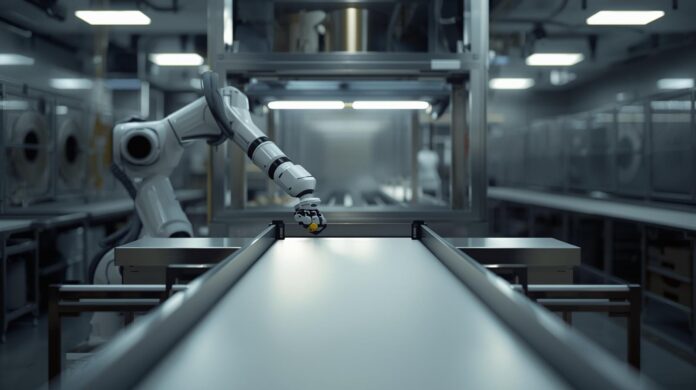
Collaborative robots, or cobots, are designed to work safely alongside people rather than behind a cage. One cobot, priced around $30,000, for example, can handle picking and sorting of small or irregular objects and runs without breaks. It doesn’t clear a staffed line. It covers a station a plant struggles to fill, and lets the workers on hand concentrate on food safety and quality control.
Material handling is another example. When a supplement manufacturer overhauled a facility, it found that paying people to move materials around the plant was capping productivity and driving cost. It deployed autonomous mobile robots to handle the intralogistics, the dull and repetitive transport work, rather than to thin out its skilled staff.
Adoption of solutions like these is on the rise. The International Federation of Robotics counts 4.66 million industrial robots in operation worldwide as of 2024, up 9% in a year and more than double the installation rate of a decade ago, with general industry (including food processing) now the largest application area, having overtaken automotive. The growth in robots is outpacing growth in the manufacturing workforce, which fits a sector adding machines to cover work it can’t staff rather than to shed workers it has.
On a plant floor, the result is a hybrid environment, with machines tackling the hazardous and monotonous tasks and people on supervision, customization, and continuous improvement. That arrangement holds up only when companies invest in training to make the collaboration work, a point worth keeping in front of any automation budget.
Some jobs will disappear, just not the way you fear
Yes, automation does displace some roles. The World Economic Forum’s Future of Jobs Report 2025, built on a survey of more than 1,000 employers, projects that technology and other forces will displace about 92 million roles globally by 2030. The same report projects 170 million new roles created in the same window, a net gain of 78 million jobs.
For manufacturing specifically, the WEF describes a dual transformation, with automation reducing demand for routine assembly work while raising demand for people who can operate, maintain, and program more sophisticated production systems. The roles don’t vanish so much as climb the skill ladder. That aligns with what food plant leaders already see, that the hard-to-fill positions are skilled and technical, and they’re becoming more so.
There are a few caveats to be aware of, however:
- The net-positive global figure hides real displacement, as 41% of employers in the WEF survey expect to reduce parts of their workforce as AI automates tasks. Individual roles and individual people are affected, which is why the transition has to be managed, not assumed.
- The new and surviving roles demand higher skills. WEF found 77% of employers planning to prioritize upskilling, because the operate and maintain jobs that replace routine ones need training the current workforce may not have yet.
For food manufacturing, sitting on a chronic, structural shortage, the practical upshot is steadier than the global average. Automation is largely backfilling labor that isn’t there rather than clearing out labor that is. The real risk for a food executive is the staffing and training one: keeping pace well enough to run the plant they already have.
Treat automation as a staffing strategy
Here are few practical ways to approach automation as part of your staffing strategy:
- Map your chronic vacancies first. Identify the roles that stay open longest and the tasks that burn out the people you do have. Those are the highest-value places to apply automation, because you’re covering a gap rather than displacing a person.
- Budget for training alongside the technology. The hybrid floor only works if your people can run and maintain the equipment. An automation purchase without an upskilling plan tends to underdeliver.
- Redeploy, don’t just reduce. Where automation frees people from repetitive work, move them toward quality, oversight, and improvement roles, the work the WEF data shows is growing and the work machines do worst.
- Treat workforce planning as a board-level constraint. With the gap structural and the demographic math fixed, staffing capacity now shapes how fast you can grow. That belongs in the capital conversation, not just the HR review.
The workers retiring this decade outnumber the ones entering, and the gap that leaves behind doesn’t close on a hiring push. That makes automation less a productivity upgrade than a way to keep the lines running with the people available. Aimed at the roles that sit empty, and paired with training for the people who stay, it covers a shortage that would otherwise cap output. Aimed carelessly, it becomes expensive equipment no one on the floor is ready to run.