
Key takeaways:
- McCormick’s combination with Unilever’s food business is a systems-and-data issue before it’s a brand story. McCormick’s Q2 filing shows integration costs already cut diluted earnings per share by $0.24, and flags digital transformation spending as a direct drag on margins.
- The parts of a merger that decide whether the synergies show up are unglamorous: reconciling ERP systems, standardizing cost data, and getting one version of the numbers. Most mid-size manufacturers can’t produce that clean version of their own data today.
- You don’t need a merger to face this. The same data issues that slow an integration also hide margin, distort costing, and stall AI projects. The audit worth running is the one McCormick’s integration team is running right now, applied to your own systems.
When McCormick agreed to combine with most of Unilever’s food business, the headlines went straight to the brands. Hellmann’s and Knorr under the same roof as French’s and Frank’s RedHot. A $44.8 billion deal, $15.7 billion of it in cash, creating a company Unilever shareholders will own 55.1% of.
But the part that determines whether this works got almost no coverage.
What really makes a food merger pay off?
The synergies live in the systems rather than the logos. McCormick told investors it expects about $300 million a year in cost savings from the combination, spanning procurement, supply chain, and overhead broadly. That number doesn’t come from a new label on a bottle. Whether McCormick reaches it depends on unglamorous, mostly invisible work, like reconciling ERP systems, standardizing cost data across two global supply chains, and getting both businesses running off numbers everyone agrees on.
That work is already showing up in McCormick’s results, and it isn’t free. In its second quarter report, the company said special charges, including transaction and integration costs, lowered diluted earnings per share by $0.24. They also list “digital transformation” as one of the SG&A cost headwinds weighing on the year. CEO Brendan Foley told investors his teams are “working with focus and discipline” on integration planning to “realize the anticipated strategic and financial benefits after the close.”
In other words, the company is spending real money now, before a single product ships under the combined portfolio, to get its systems and data in order. That spending is the actual work of the merger, not a footnote to it.
Why data integration decides the outcome
When a deal underdelivers, the failure is usually operational rather than strategic. A company’s CRM and ERP should serve as “the integration engine, not just a repository.” Advisors suggest connecting those systems for real-time cost and inventory visibility, and using them to enforce standardized processes across legacy and acquired businesses.
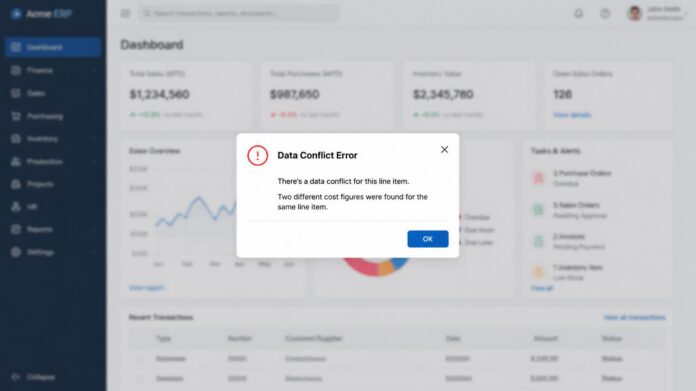
The key word there is standardized. Two companies merging almost never code their data the same way. One tracks a raw material by supplier SKU, the other by internal part number. One books freight into cost of goods, the other into overhead. Until those definitions get reconciled, “combined margin” is a guess. The integration team’s real job is turning two incompatible versions of the truth into one.
This isn’t a rare problem. 2025 saw Mars close its $35.9 billion acquisition of Kellanova and Amcor close its $15.4 billion purchase of Berry Global, both described as bets on scaled, integrated platforms. And nearly half of 2024 M&A activity in consumer products came from divestitures, which means more businesses being carved apart and bolted onto new owners, each one a data integration project waiting to happen.
What this means if you’re not merging anything
Even if you have no deal on the table, the data problems that surface during an integration are already in your systems. A merger just forces you to look at them.
Ask your own team the questions McCormick’s integration planners are asking right now:
- Can you produce a single, trusted landed cost for your top 20 SKUs without someone rebuilding it by hand in a spreadsheet?
- If someone asked which customers you actually make money on after freight, rebates, and returns, how long would it take, and would two people give the same answer?
- When your ERP and your CRM disagree about a customer, an order, or a price, which one wins, and does everyone know?
If those questions are hard to answer, you’re carrying the same hidden cost McCormick is paying down publicly. The difference is you’re probably paying it in margin you can’t see and decisions made on numbers you can’t fully trust.
AI thrives on clean, connected data
Every food manufacturer is being pitched AI right now, whether it’s demand forecasting, dynamic pricing, or predictive maintenance. Most of those projects stall for a reason that has nothing to do with AI. It’s because the underlying data is inconsistent, incomplete, or scattered across systems that don’t talk to each other.
An AI model trained on cost data that means three different things in three different plants doesn’t produce insight, just confident nonsense. The manufacturers who will get returns on AI in the next few years are the ones who did the boring work first. They have one clean, consistent, connected version of their operational data. The same foundation an integration team builds is the foundation an AI project needs. McCormick named both digital transformation and integration in the same breath, because for them, they’re the same project.
What to do this week
You don’t need a $44.8 billion deal to justify getting your data house in order. Pick one number that matters (e.g., landed cost, customer profitability, true plant yield) and trace how it’s produced today. Count the manual steps. Count the systems involved. Count how many people would give you a different answer.
That count is your integration debt. McCormick is paying its version down in front of shareholders, one quarter at a time. Yours is sitting on your balance sheet too. It’s just not labeled.