
Key takeaways:
- AI tools are cutting the time required to build and maintain Hazard Analysis and Critical Control Points (HACCP) plans from weeks to hours, with implications for audit readiness and quality team capacity.
- Fewer than 30% of food manufacturers globally have fully integrated AI-based traceability systems, according to BCC Research, meaning early movers still have meaningful ground to claim.
- Before evaluating any vendor, the questions that matter most aren’t about features. They’re about integration fit, data readiness, and whether the tool supports regulatory alignment without displacing human judgment.
Something in food safety technology has been building in the background for the past few years. A new class of AI startups has moved beyond the automation tools that first captured the industry’s attention. Their focus is on the documentation-heavy, compliance-critical work that quality assurance (QA) teams handle every day.
HACCP plans, corrective action logs, standard operating procedures (SOPs), audit reports — work that once took days or weeks now takes hours on the right platform. That’s the pitch. For many teams, it’s delivering. Whether it’s the right investment for your operation depends on questions most vendors won’t walk you through.
Here’s what the current generation of tools can actually do, and what to think through before you buy.
How AI is cutting HACCP plan build time from weeks to hours
The most common application is documentation automation. HACCP requires food manufacturers to document every potential hazard in a production process, identify the critical control points (CCPs), and define exactly what happens when those controls fail.
Historically, this work has been manual. Teams maintain binders, update spreadsheets, and rebuild plans from scratch when processes change. The volume of documentation scales with facility complexity, and a single ingredient or supplier change can trigger a cascade of updates.
AI-powered tools now ingest existing SOPs, process flowcharts, and product specifications, then use that information to generate HACCP frameworks automatically. A complete HACCP plan can be generated in under 30 minutes by a system analyzing a company’s product and process data. A facility could potentially move from paper records to a structured digital food safety system in under a week.
Beyond documentation, these platforms extend into several other high-value applications:
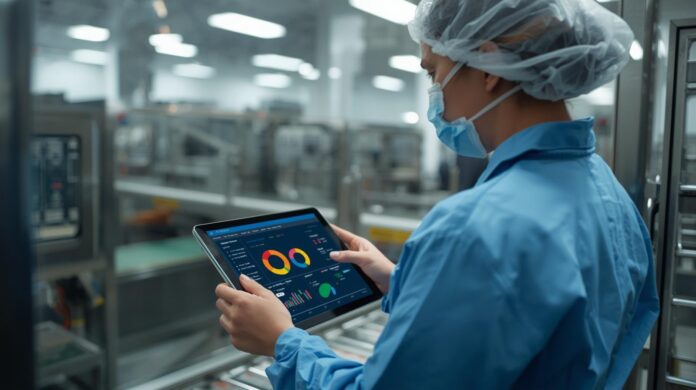
- Real-time CCP monitoring: Internet of Things (IoT) sensors connected to AI platforms track temperature, pH, humidity, and other variables at critical control points around the clock. Automated alerts fire when readings drift outside acceptable limits, replacing manual checks that might happen every few hours with continuous oversight.
- Vision-based quality inspection: Computer vision systems scan production lines for foreign materials, defects, and contamination, faster and more consistently than manual inspection. For example, an AI monitoring system for handwashing compliance helps increase adherence rates while automatically logging data for auditors.
- Predictive analytics: Machine learning models analyze historical HACCP data, environmental monitoring results, and microbial testing trends to flag risk patterns before a deviation becomes a recall. This is the shift from reactive to preventive quality management that the industry has been working toward for years.
- Regulatory intelligence: Some platforms now monitor changes to Food Safety Modernization Act (FSMA) requirements, Global Food Safety Initiative (GFSI) standards, and other regulatory frameworks, then flag updates relevant to your specific operation.
Why less than 30% of manufacturers have fully adopted AI-based traceability
According to a market analysis published by BCC Research in August 2025, the global AI in food safety and quality control market was valued at $2.7 billion in 2024 and is projected to reach $13.7 billion by 2030, a compound annual growth rate (CAGR) of 30.9%.
The same research found that more than 60% of current AI adoption in food manufacturing concentrates on real-time quality inspection and contamination detection. Traceability integration is still catching up: fewer than 30% of global food manufacturers have fully integrated AI-based traceability systems.
This background comes into play when you’re evaluating vendors. A platform that excels at real-time monitoring may not yet have the traceability depth required for FSMA 204 compliance or rapid recall response. Know which problems you’re solving before you evaluate which tools solve them.
A peer-reviewed study published in Frontiers in Nutrition in February 2025 reviewed AI applications across food manufacturing and identified clear patterns in where the technology adds the most consistent value:
- Reducing waste through predictive modeling
- Ensuring product consistency through real-time process control
- Enabling audit-ready documentation
The same study flagged persistent barriers to adoption:
- Infrastructure limitations
- Data privacy considerations
- The upfront economic costs of implementation
But with the right preparation, those barriers are manageable.
What to evaluate before you buy
Integration with existing systems determines whether this works at all
Most facilities already run enterprise resource planning (ERP) systems, production scheduling software, and laboratory information management systems (LIMS). An AI food safety platform that can’t connect to those systems via application programming interfaces (APIs) creates new data silos rather than solving old ones.
Ask vendors: Which ERP systems do you integrate with, and do you have reference customers using those integrations in live production environments?
Regulatory coverage isn’t the same as regulatory alignment
Many platforms claim compliance with FSMA, SQF, BRCGS, and other standards. That’s worth verifying, but the more important question is how the platform handles regulatory changes.
Ask vendors: Can it automatically update documentation workflows when standards shift? Or does that require manual reconfiguration every time the FDA or a certification body updates its requirements?
Understand what the system can’t explain
If a machine learning model flags a potential hazard or auto-generates a HACCP recommendation, quality teams need to understand the reasoning behind it — not just for operational purposes, but because auditors will ask.
Ask vendors: How does the platform present its outputs? Can our team trace a recommendation back to the underlying data?
Frontline adoption requires more than a training session
QA teams and production workers can respond negatively to AI-driven monitoring, particularly when the technology is perceived as surveillance rather than support. A rollout that doesn’t address this creates resistance that undermines the tool’s effectiveness before it gets started.
Ask vendors: Does the platform have role-based access and a user interface design for frontline employees? Do you provide change management resources or just technical support?
Your timeline should account for data preparation
Vendors often quote implementation timelines based on ideal conditions like clean data, well-documented processes, and straightforward ERP integration. But most facilities need to clean and structure existing records before onboarding. Building that step into your timeline and budget is the difference between a working implementation and a stalled pilot.
A thoughtfully integrated platform, built on clean data and deployed to a prepared team, will outperform a more sophisticated platform dropped into unprepared operations every time.
FAQ for food manufacturing leaders
Q: Do we need to replace our existing HACCP documentation to work with AI platforms?
A: Most current platforms are designed to ingest existing documentation and build from there. The more complete and consistent your existing records are, the faster the onboarding. If your records are fragmented or inconsistent, expect to spend time on data cleanup before implementation begins.
Q: How do AI-generated HACCP plans hold up in audits?
A: It depends on the platform and how it’s configured. Well-implemented systems produce documentation aligned with FSMA, SQF, BRCGS, and other audit requirements. That said, regulators and third-party auditors still expect human review and sign-off. AI-generated documents are a starting point. Your quality team validates the outputs; they don’t replace them.
Q: Will AI quality control tools reduce our QA headcount?
A: The better-designed systems extend QA team capacity rather than replace it. Real-time monitoring and automated documentation handle repetitive, time-intensive tasks so QA professionals can focus on analysis, trend interpretation, and corrective action decision-making.
Q: What’s a realistic ROI timeline?
A: It depends on your starting point. Facilities moving from paper-based to digital HACCP systems often see immediate improvements in audit preparation time and documentation consistency. More sophisticated applications like predictive analytics and vision-based inspection typically take longer to prove out at scale. Portfolio-level benefits from AI investments in food manufacturing generally materialize over 18 to 36 months, especially when data cleanup and workflow redesign are part of the project.
Q: How do we separate legitimate vendors from oversellers?
A: Ask for reference customers in your product category and at your scale. Ask how the platform handles a specific regulatory update, including who makes the change, how fast, and how your team is notified. Ask what happens to your data if you exit the platform. Vendors with mature products and real track records will answer those questions without hesitation.