
Sponsored by FoodSafe Drains

Food and beverage manufacturers understand cycles. Brands are currently expanding and optimizing existing plant facilities to increase product volume and drive product innovation. Corporate VPs envision plant upgrades as a way to hedge against any current economic uncertainty while modernizing plants to enable complete digital operations and AI enabled strategies.
“Staying with the status quo in food plants is a recipe for food safety issues,” says Viking Kristjansson, VP of Sales Engineering at FoodSafe Drains. “Modern, food safe drainage systems are transforming facilities by enhancing safety, hygiene, and efficiency.”
In many critical industries drains have, for too long, been treated as an afterthought, or as a simple part of the plumbing waste stream. This has led to the installation of a patchwork of drains in processing and manufacturing facilities across North America. Compounding the issue, these random floor drains often feed into an invisible network of underground plumbing.
Legacy problems of degraded underground piping and excessive floor slopes are creeping up on many facilities, whose decades old drainage is leading to consistent maintenance and safety issues. Companies are starting to unravel these twisted networks of piping and are asking how retrofit and replacement can lead to better outcomes.
Legacy drainage challenges
Three major challenges are faced by plant managers in legacy facilities. Working to identify these challenges can help inform decisions about how to prioritize upgrade work within the building envelope.
1. Over-reliance on trench drains
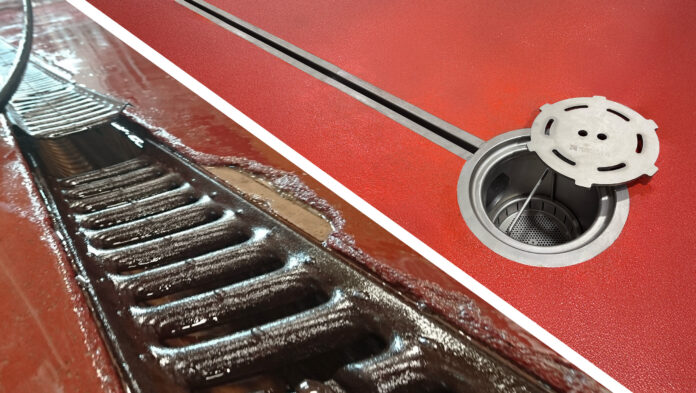
Cleaning heavy trench drains is time-consuming, and these structures can erode over time due to heavy equipment and traffic, leading to structural defects and hazards. Moreover, trench drains have a higher risk of contamination and can trap bacteria more than slot drain systems.
We have seen broken grates in facilities that present hazards to both employees and equipment. Once these grates become damaged, it becomes even harder for them to be cleaned. This can lead to a spiral where staff avoid touching these drains because of their condition, leading to further degradation of the drainage system.
2. Workforce culture and training
Replacing legacy drainage systems is an excellent step for brands, but instilling a food-safety-first culture goes a long way toward reducing food safety incidents. A modern sanitation installation aids plant managers in refocusing maintenance personnel on new tools and the ability to update cleaning and standard operating procedures.
Broken grates and drains lead to a culture of unsanitary practices. Without a clear cleaning SOP workers have no clear direction. This can lead to a feeling of apathy as they are unable to clean degraded equipment properly, leading to a spiral of long-term drainage issues.
3. Lack of visibility
A lack of qualified sanitation designers led to the widespread use of area drains in legacy plants. Area drains make cleaning easier, but they create a lack of visibility into food safety for personnel because they hide food safety issues inside a network of invisible piping.
We have had plant managers tell us that they know they have listeria in their underground and their job is to keep it there. This approach leads to a ticking time bomb of food safety issues.
Finding the right design is essential in today’s food plant, and installing a range of flooring drainage types is the right approach.
Strategic approach for an entire facility
Designing an efficient drainage system for food production facilities demands a carefully tailored strategy, as there is no one-size-fits-all solution. Critical considerations include contamination risks, frequency of washdowns, water flow volume, exposure to high temperatures or harsh chemicals, equipment weight, and floor slope. Even aesthetics play a role in customer-facing spaces like wineries.
There are three types of drains commonly used in food production facilities: area drains and two types of linear drains — grated drains and slot drains. Choosing the optimal solution for each application and area is key to creating an effective system.
Accessibility: Area drains vs. linear drains
Traditional area drain systems present significant challenges due to their extensive underground piping, which is difficult and expensive to access and clean. For instance, in a 4,800-square-foot facility, an area drain system typically includes about 244 feet of buried pipes. These hidden pipes cannot be visually inspected or physically cleaned without specialized equipment, creating an environment where contaminants and bacteria can accumulate over time, unnoticed and unchecked, and solids accumulate, reducing flow and causing blockages.
Linear drain systems, on the other hand, are designed in a way that reduces the need for extensive underground piping, making drainage channels significantly easier to access for cleaning and maintenance. For instance, in the same 4,800-square-foot facility, a linear system with a 100-foot slot drain would require just 10 feet of underground piping. This substantial reduction in buried infrastructure simplifies inspections and maintenance, enabling staff to efficiently keep the drainage system in optimal condition.
Area drains demand a costly and complex four-slope floor design around each drain. In our example, this requires a total of 48 individual slopes, compared to only four for a linear drain system. Besides the higher construction costs and added complexity, this design creates uneven floor surfaces, reducing both efficiency and safety for workers and wheeled equipment.
Cleanability: Grated drains vs. slot drains
Linear drains come in two primary forms: grated drains and slot drains. While both provide access to the drainage channel for cleaning, their designs differ significantly. Grated drains use removable grates to cover the channel, while slot drains offer a narrow, open, and sleek design that eliminates the need for a grate altogether.
Grated drains have their place but come with their own set of issues. They can trap bacteria, leading to unpleasant odors and a higher risk of contamination. Cleaning them is a labor-intensive, time-consuming task due to the heavy, cumbersome grates, which can be difficult to handle. Many older drainage systems were not built to withstand the weight of modern, heavy machinery, such as autonomous material-handling equipment. This often results in warped grates, which not only endanger workers but also damage wheeled equipment.
Slot drains by contrast have no grates and are designed to be easy to drive over for both large equipment and wheeled hand carts. Advanced manufacturers will often design cleaning equipment and SOP’s tailored to their slot drain products, contributing to a culture of hygiene within the building envelope.
A smarter approach: Whole-building drainage solutions
A whole-building approach to drainage ensures that every area of a facility has the optimal system for its specific needs. While slot drains offer exceptional performance in many applications, a comprehensive drainage strategy integrates multiple solutions tailored to different parts of the facility:
- Area drains: Best for compact spaces such as processing zones or equipment washdown areas, these drains effectively collect and remove water where space is limited.
- Grated drains: Ideal for areas with high-water-volume and lots of solids like production floors and packaging lines, grated drains prevent pooling and flooding while accommodating heavy traffic.
- Slot drains: The gold standard for sanitary drainage and food safety, slot drains combine durability with effortless cleaning. Their sleek, grate-free design provides a seamless, modern look, while advanced models include clean-in-place (CIP) technology and robust construction capable of withstanding forklift traffic. These discreet systems are particularly well-suited for customer-facing areas where aesthetics matter.
By strategically incorporating these drainage types based on facility needs, manufacturers can optimize food safety while reducing maintenance costs.
Advancing whole facility upgrade projects
Companies are now beginning to understand that upgrade work needs to be coordinated around production schedules. This has led to degraded drainage systems becoming the norm in far too many legacy plants run by large and trusted names in food and beverage production. These drains present a gaping hole in the careful food safety apparatus that these companies have developed and present major liabilities in terms of contamination and regulatory risks.
Large capital investments into the upgrade of existing legacy facilities and the construction of new buildings demands proactive planning and competent management. Food plants often run 24/7 with limited time for shutdown on weekends or holidays, leaving tight windows to complete this type of work. However companies are innovating and developing solutions to bridge the gap for customers by offering value added services.
Global Drain Technologies offers a drainage evaluation program to inspect and assess existing facility drains relative to overall design functionality. This allows for a recommended action plan, including timelines that account for production shutdowns, to be proposed for plant modernization. Food and beverage producers must also carefully vet contractors, checking references to ensure they are experienced, trusted, and capable of performing the required work.
The bottom line when selecting a provider for your modernization or upgrade project is to come to the table informed. Understanding how drains interact with facility design and production will ensure that you receive a functional and hygienic drainage system and will sustain your production activities for decades to come.
 By Viking Kristjansson, VP of Sales Engineering at FoodSafe Drains, a division of Global Drain Technologies