
Key takeaways:
- Food manufacturers generated $42.6 billion in surplus food in 2024, 11% of the total value of surplus food across all U.S. sectors, with the majority originating from byproducts and production line waste, not finished goods.
- Manufacturing line optimization ranks second among all food waste solutions for total greenhouse gas emissions reduced, and fifth for tons of food diverted, making it both an environmental and operational lever.
- Strong data foundations, cross-functional coordination, and executive-level commitment, help companies make the fastest progress on food waste.
This Earth Day, the sustainability wins worth talking about are the ones that also make business sense.
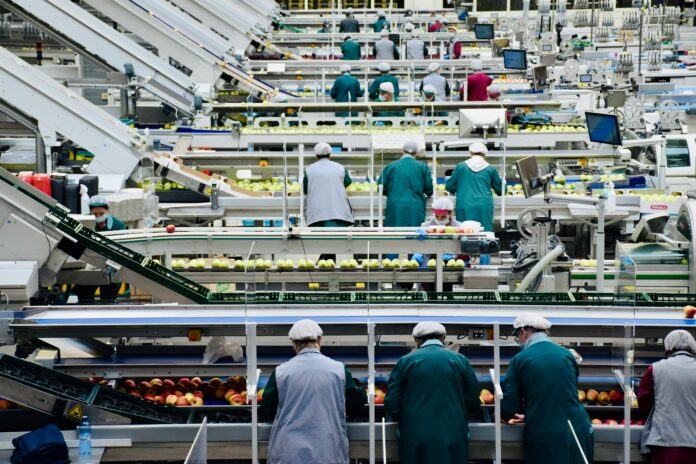
Every production line has trimmings, over-runs, changeover losses, and the occasional batch that doesn’t meet spec. That’s just what manufacturing looks like at scale. But according to the 2026 ReFED U.S. Food Waste Report, the aggregate cost adds up fast.
Food manufacturers generated 14.6 million tons of surplus food in 2024, valued at $42.6 billion. That’s 11% of the total value of surplus food generated across all U.S. sectors, the second-largest share behind consumer-facing businesses. Across the food system, trimmings and byproducts account for 30.4% of all surplus food, the single largest cause, followed by excess production at 23.7%.
Peels, stems, bones, off-spec trimmings, and material lost during line changeovers are familiar sources of loss for most manufacturers. Understanding where your volume is concentrated is step one; it’s easier to reduce what you can measure and locate.
Prevention generates the most value, up and down the chain
Keeping food from becoming surplus in the first place generates the most environmental benefit because it preserves all the resources (water, energy, and raw ingredients) already invested in producing it. Diversion to recycling destinations like animal feed or composting is valuable, but it can’t recover what was already spent producing food that never reached its intended use.
ReFED’s modeling of 47 food waste solutions identifies prevention as the priority whenever possible, because every resource invested in growing, moving, and processing that food is also lost with the food itself.
The top solutions include line optimization and upcycling
The food waste reduction approaches with the most traction include:
- Line optimization: Re-engineering changeover procedures and product sequencing helps reduce material lost when a line switches between products. Small adjustments can compound meaningfully over time.
- Byproduct utilization: This involves redirecting edible trimmings into secondary products, livestock feed, or upcycled food lines. Upcycling is maturing from isolated product plays into broader platform approaches that process multiple byproduct streams into consistent industrial inputs, a model whose economics improve further when facilities are sited near large processors.
- AI-enhanced demand planning: AI-powered tools that help manufacturers right-size production and sharpen inventory accuracy raised over $30 million in private funding in 2025. Newer solutions in this category are being deployed alongside cameras, sensors, and scanners to identify operational bottlenecks and reduce overproduction, particularly useful under current supply chain pressures.
- Packaging adaptations: Developing packaging that transfers more easily between supply chain contexts (e.g., formats that work for both foodservice and retail) reduces the volume of product that becomes unsellable due to a channel mismatch.
Progress on food waste starts with visibility
Food waste reduction is increasingly being elevated to the C-suite and boardroom, recognized as a business decision with material impact on the bottom line. But recognition and action aren’t the same thing. Across 75 companies analyzed in retail, foodservice, manufacturing, and quick-service restaurants, 73% cite food waste as a specific issue in their public reporting, but only 37% disclose a measurable reduction target.
What distinguishes faster movers is having the right internal conditions, including reliable waste data, functions that share accountability, and leadership that treats reduction as a business priority. Without those, even good solutions stall at the pilot stage. The business case often only becomes visible once companies start measuring. When waste doesn’t show up in financial reporting, the cost of inaction is easy to overlook, but quantifying it tends to shift the conversation quickly.
California is moving forward on climate transparency regulations
In California, regulations on GHG emissions reporting go into effect this year for Scope 1 and Scope 2 emissions. In 2027, emissions from food waste will be included when Scope 3 goes into effect, applying to U.S. partnerships, corporations, and limited liability companies (LLCs) with over $1 billion in annual revenue doing business in the state.
For large manufacturers with California exposure, that timeline is closer than it looks. Reducing manufacturing surplus now builds the data infrastructure those disclosures will require.
2024 marked the first meaningful decline in U.S. food waste since the pandemic
Total surplus food in the U.S. declined 2.2% in 2024, the first meaningful year-over-year reduction since a pandemic-related dip, representing 1.57 million fewer tons of surplus food and 844,000 fewer cars’ worth of GHG emissions. ReFED describes this as a potential inflection point, driven by a combination of business investment, supportive policy, and behavioral change.
Private sector investment in food waste solutions rose 16% in 2025, driving total sector funding up 6% to $794 million. That capital is increasingly flowing toward solutions with demonstrable returns, suggesting that the financial case is becoming clearer, not just the environmental one.
For manufacturers looking to get more specific about where their own losses occur, ReFED’s Insights Engine includes a financial analysis of more than 40 food waste reduction solutions, an impact calculator, and a searchable directory of solution providers organized by sector and approach.