

By Bob Grote, Chief Executive Officer, The Grote Company Family of Brands
Key takeaways:
- Food processors are moving forward with equipment investments despite economic headwinds, driven by protein and healthier-eating trends. But flexibility and modularity are becoming priorities over large fixed-line commitments.
- Automation and AI adoption is accelerating in targeted areas like quality control and vision systems, but ROI proof, food safety design, and skilled technician availability remain real barriers to broader deployment.
- Customer centricity is emerging as a competitive differentiator in B2B equipment relationships. Processors are choosing vendors based on how they’re served, not just what they’re sold.
Looking back at the first quarter of 2026, here are a few of the issues on the minds of food processors and insight on what may lie ahead.
1. Overall economic climate
In the U.S., economic momentum seems to be picking up, as the industry adjusts to tariffs and interest rates are staying put. Processors are moving forward with their investments in new or upgraded equipment.
Europe is seeing slower economic growth; however, there are pockets of opportunity there as well.
The impact of the Iran War is being felt in higher fuel prices, which will almost certainly cause food prices to increase.
The protein push, along with the healthier eating and overall living trends, may be one factor driving investment. While processors understand they could postpone investing in equipment, there’s always the risk of being eclipsed by a competitor if they wait.
2. Automation, robotics, and AI adoption
Automation is always a hot topic in the industry.
There simply isn’t enough labor to fill all the roles that are needed to keep up with demand. Adopting the right level of automation can maximize uptime, consistency, and flexibility.
Meanwhile, some tasks are difficult or undesirable for humans to do day after day. Repetitive, high-volume tasks in cold or wet environments are ideal candidates for automation, which can improve efficiency and safety. Adding technology into the process, especially at these pain points, can yield better results for processors.
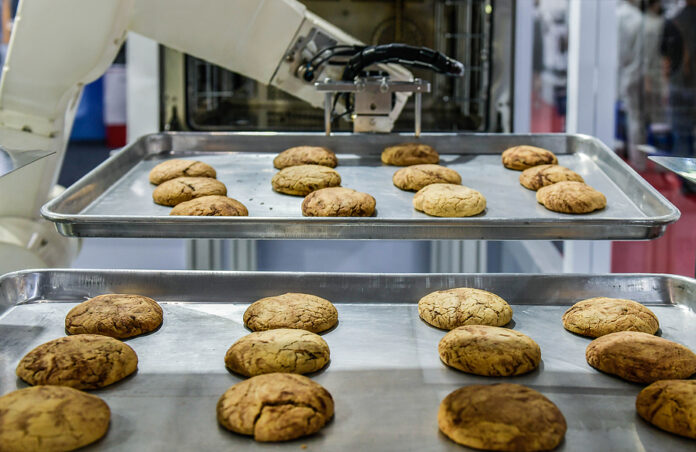
One example is decorating bakery items, like cakes. When done by hand, it may be difficult to maintain quality. The process needs to be repeatable. Robotics can save time while also ensuring quality doesn’t suffer.
Then there’s AI to consider. Customers often fear being on the bleeding edge of any technology. They’re already making products, so unless there’s proof that the technology can somehow improve their throughput, they’re probably going to be reluctant to invest in it. They’re going to want to stick with what works.
Some early adoption areas include internal use cases, such as improving efficiency in equipment design.
Quality control is another area seeing some early wins. One example involves building a feedback loop using AI and vision system technology. It enhances the equipment’s existing capabilities and repeatability. If you can show that this increases processors’ yield, they’re more likely to pay for it.
Using AI to detect issues earlier in the packaging process can save producers significant time and money. Detecting an issue before the package reaches the end of the line is worth a lot.
As automation is adopted more widely for food handling versus just the handling of boxes and pallets, the importance of designing equipment with food safety in mind increases. If not well designed and easy to clean and sanitize, the risk of contamination increases.
Of course, as you add more automation, you need skilled technicians and engineers to support these advanced systems. The lack of this talent may be another factor setting adoption back. When automated systems go down, processors need to consider maintenance and contingency plans.
One question that should always be considered: Does the technology justify the cost?
3. Food industry trends, including protein and healthier eating
The protein push, along with broader healthier-eating trends, may be driving investment in new equipment. We see a continued shift toward consuming more meat and protein-enriched products. Even Doritos has launched a new version with 10 grams of protein per serving and is planning more protein-heavy products.
The FDA’s updated “healthy” definition went into effect in February, with full compliance required by 2028. Reformulation may require retooling due to policy changes on food dyes. This impacts not only R&D but also procurement, labeling, and marketing.
Watch for this to play a role in processors’ planning and decision-making. Some processors may decide to design around product families to help facilities be more adaptable.
Processors may be looking to invest in more flexible operations amid market unpredictability. More modular, retrofit solutions may be the answer.
4. The age of customer centricity
Customers want to work with vendors that allow them to do business the way they want to. Meeting customers where they are in a B2B relationship matters. If they’re happy, they’ll tell others. The same is true if they’re not.
Even with automation, it’s critical to maintain a focus on customer experience. Not every company is nailing that. Some may remove the human element to save money, but is it worth it?
For example, if a customer wants to call the vendor to talk through troubleshooting with a technician rather than submit an online ticket, you want to provide that service. If they want a single invoice instead of multiple, the vendor should make that happen.
By understanding that each customer is different and paying attention to that, you can differentiate yourself. If you don’t, they may choose to work with another vendor.
5. Consolidation among suppliers
Amid economic uncertainty, some owners may be seeking an exit strategy, creating opportunities for those looking to make acquisitions. For owners considering a move, market fluctuations may be what pushes them to sell. Often, the question becomes, do we want to continue riding the waves, or is now the time to find the right buyer?
Further, the best fit for a smaller company may be an acquisition by an agile, family-owned business that can ensure employees keep their jobs and maintain the culture that’s been built over the years. It’s wise to consider all the options.
Food processors adjust and move forward
Even as challenges arise in the food processing industry, we continue to adapt and move forward.
As we know, everyone has to eat, so there will always be opportunities. By making adjustments where needed without losing sight of the human element in our business, we can make strides toward better serving our customers.
 Bob Grote is the chief executive officer of the Grote Company Family of Brands. This includes Grote Company, PFI, Vanmark, ProFab, SPI Automation, and McCabe’s.
Grote became CEO in 2008 and now focuses on developing industry partnerships and seeking the latest food technologies. He has overseen eight acquisitions in 10 years and grown the Grote Company Family of Brands from a regional manufacturer into a global network with 11 locations.